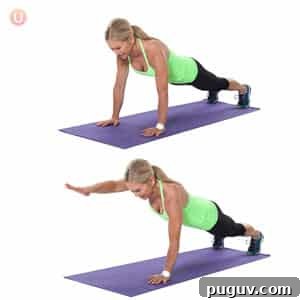
The Plank to Single Arm Reach is an effective core-strengthening exercise that also improves balance, shoulder stability, and overall body control. This variation builds on the traditional plank by removing one point of contact and adding a controlled arm reach, forcing the core and stabilizing muscles to work harder to keep the spine aligned and the body steady.
Planks are widely recommended by fitness professionals because they train the entire midsection—abdominals, obliques, and lower back—while also engaging the glutes, shoulders, and legs. The single-arm reach increases the challenge by shifting load and demand across the torso, which is especially useful for developing unilateral stability and addressing side-to-side strength differences.
Before attempting the Plank to Single Arm Reach, make sure you can hold a proper standard plank for at least 30 seconds with good form: shoulders stacked over wrists, hips level, and the body forming a straight line from head to heels. If you are not yet comfortable with a full plank, start with beginner variations such as a knee-supported plank or a modified plank to build strength and endurance.
How this variation works: when you lift one arm and reach forward, you remove a stabilizing limb and create rotational and lateral forces across the torso. To counteract those forces, the deep core muscles—including the transverse abdominis and obliques—must engage more strongly. The shoulders and upper back must also stabilize to control the reach and return. Practicing this move regularly improves functional balance that carries over to everyday tasks and athletic activities.
Plank to Single Arm Reach Exercise Instructions
- Start in a high plank: hands under shoulders, feet hip-width apart or slightly wider for more stability, and the body in one straight line from head to heels.
- Brace your core by pulling the lower abdominals toward the spine. Keep the neck neutral and gaze down to maintain alignment.
- Slowly lift your right arm straight out in front of you, reaching forward while keeping the rest of your body steady. Avoid rotating the hips or letting the shoulder shrug up toward the ear.
- Hold the reach for one or two seconds, then lower the arm back to the starting position with control. Repeat on the left side.
- Continue alternating sides for the desired number of repetitions or time interval.
Suggested sets and reps: For beginners, try 3 sets of 6–8 reaches per side, focusing on control and form. Intermediate exercisers can aim for 3 sets of 10–12 reaches per side or perform timed intervals (for example, 30–45 seconds of alternating reaches). Adjust reps and holds according to your strength and stability levels.
Modifications and progressions: If your low back sags or you cannot maintain a straight line, perform the kneeling version of this exercise to reduce load and practice the single-arm reach pattern. To increase difficulty, narrow your base of support by bringing feet closer together, slow the tempo, add a light weight in the reaching hand, or combine the reach with a leg lift on the opposite side for an advanced challenge.
Common form cues: keep the hips level and square to the floor, draw the ribs down and the tailbone slightly tucked, breathe steadily and avoid holding your breath, and move deliberately rather than quickly. If you feel pain in the lower back or shoulders, stop and reassess form; regress to an easier variation if needed.
Primary targets: the Plank to Single Arm Reach works the core (abdominals and lower back), shoulders, and upper back, while also recruiting the glutes and legs to maintain proper posture. Because it challenges unilateral stability, it is an excellent addition to a balanced strength routine and can help improve functional movement and balance across all ages.