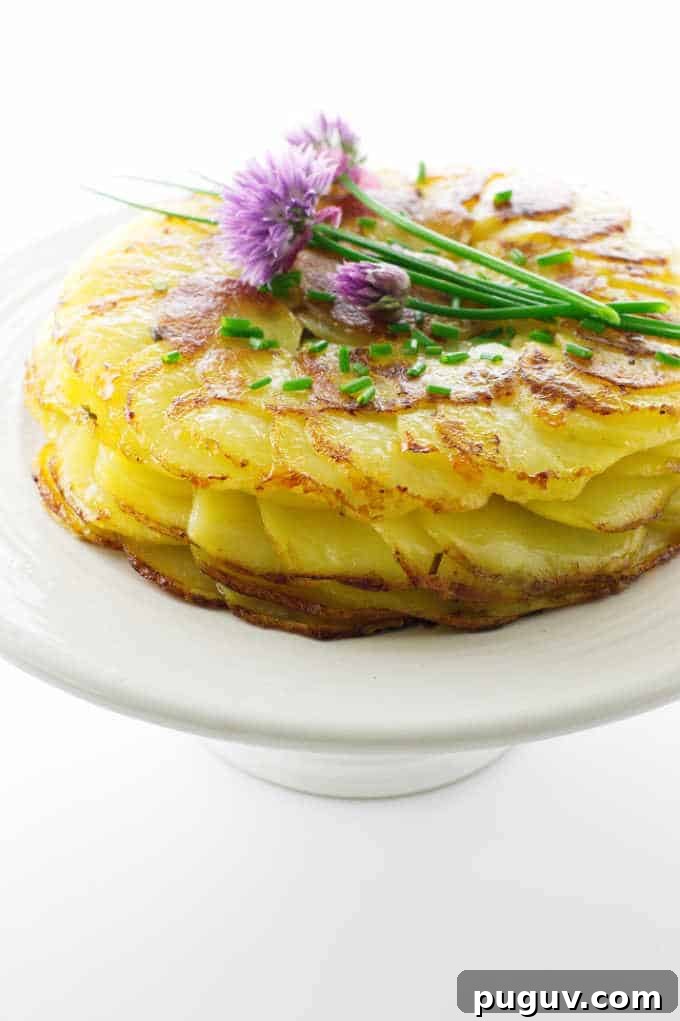
Potatoes Anna, also known as Pommes Anna, is a timeless French classic: thinly sliced potatoes layered and baked into a crisp, golden cake. Brushed with clarified butter and seasoned with salt and pepper, the finished dish develops crunchy edges and a tender interior. Garnishing with snipped chives and chive blossoms adds color and a mild oniony brightness, making this an elegant side for any special meal.
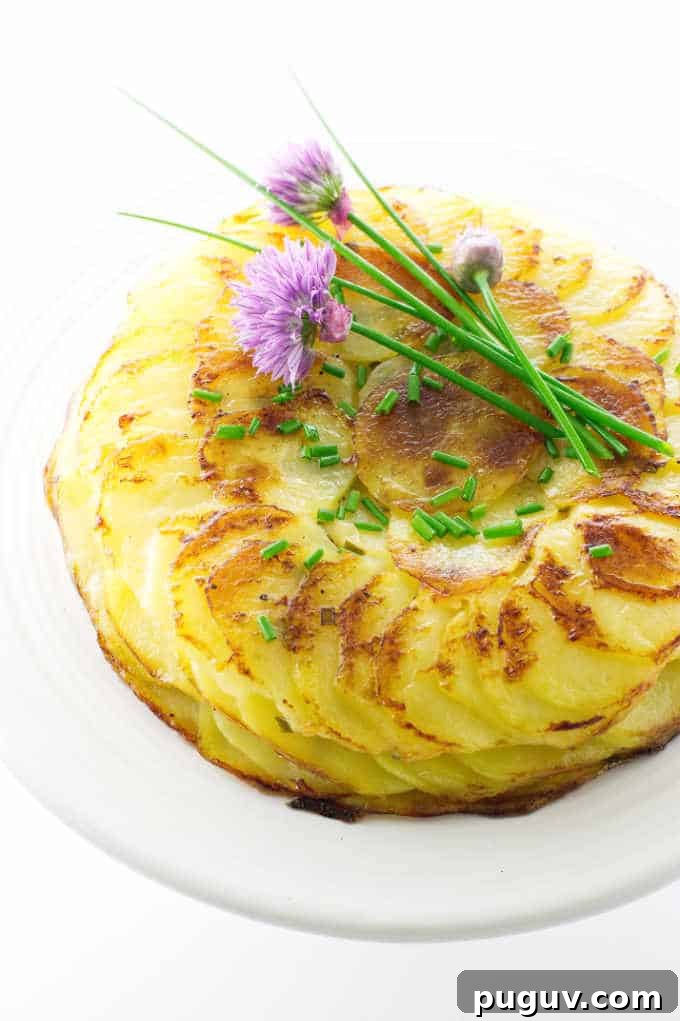
This humble tuber becomes a stunning centerpiece when transformed into a compact, buttery cake made from uniform slices, clarified butter, and simple seasonings. The technique is straightforward but benefits from attention to slice thickness, compression, and even browning.
What is clarified butter?
Clarified butter is pure milk fat separated from the water and milk solids in regular butter. When gently heated, the water evaporates, foam rises to the surface, and the solids settle to the bottom. Straining or skimming off the foam and pouring the clear golden fat away from the solids yields a clean, richly flavored butterfat ideal for high-heat cooking.
Clarified butter has a smoother, more concentrated buttery flavor and a higher smoke point than whole butter, which helps prevent burning during searing and roasting. It also keeps well in the refrigerator, so preparing a batch ahead of time is convenient for many recipes.
Benefits of using clarified butter
- Richer, silkier butter flavor that remains pure and distinct in dishes.
- Higher smoke point (about 450°F) than whole butter, reducing the risk of burning during browning.
- Longer shelf life when refrigerated, so you can keep it on hand for finishing or frying.
Why clarified butter for Potatoes Anna?
Clarified butter lets the pure buttery taste shine while tolerating the higher heat used to crisp the exterior. Because the milk solids are removed, the fat browns evenly and produces an attractive golden crust without smokiness.
Tips and tricks for perfect Potatoes Anna
The key to an excellent Potatoes Anna is compression—firmly compacting the layered potatoes so they bind together and form a dense, crusty cake. Follow these tips for consistent results:
- Choose starchy potatoes such as Russet or Yukon Gold. Their higher starch content helps the slices adhere to one another and hold shape when inverted.
- Do not rinse or soak the sliced potatoes. Leaving surface starch intact helps bind the layers during baking.
- Slice very thinly—about 1/8 inch. A mandoline or a food processor slicing disc will give uniform slices for even cooking.
- Brush each layer with clarified butter and season with salt and white pepper as you build the cake. Alternate the direction of each layer to stabilize the structure.
- After assembling, briefly sear the pan on the stovetop to begin browning, then cover with foil and press with a smaller pan or plate. Bake, compressing once or twice during the covered stage, then finish uncovered until the top is golden and the potatoes are tender.
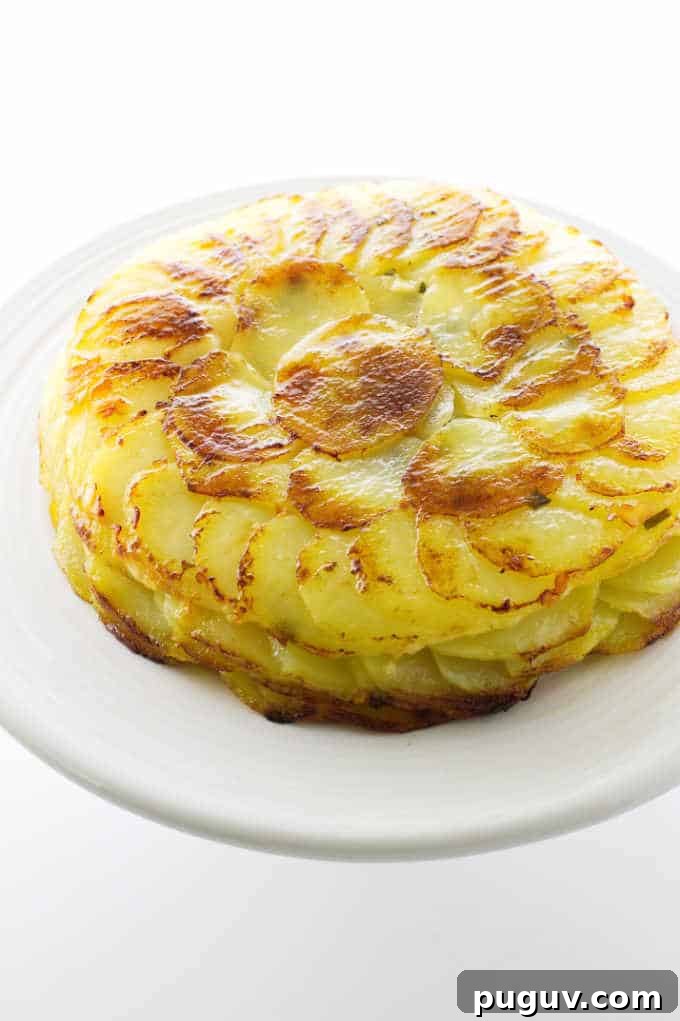
- Once baked, invert the skillet onto a plate so the cake releases as a round, compact disk. Drain excess butter before serving if desired.
Potatoes Anna is elegantly simple—traditionally it contains only potatoes, butter, and seasoning—yet it accepts subtle variations. Try adding grated hard cheese between a few layers, a hint of garlic, or fresh herbs for a personalized touch.
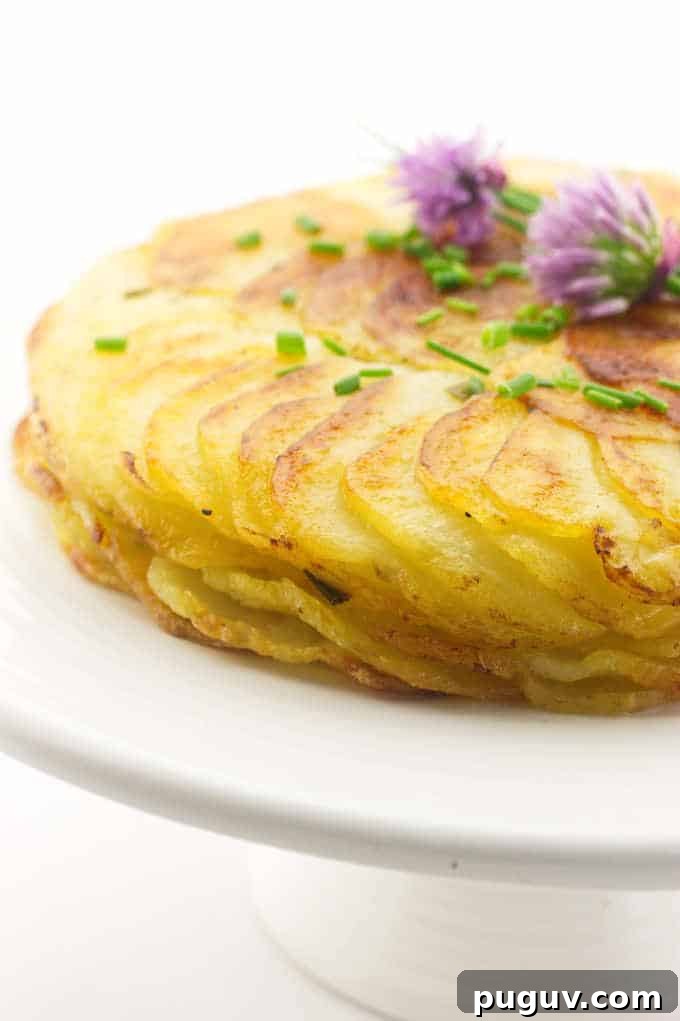
For a decorative finishing touch, garnish with freshly snipped chives or small edible chive blossoms. These add a delicate color contrast and a mild onion note that complements the rich butteriness.
Make ahead and reheating
You can prepare and bake Potatoes Anna up to eight hours ahead. Allow the cooked cake to cool completely, then cover and refrigerate. Reheat in a 350°F oven for about 15 minutes to regain warmth and crispness before serving.
Ingredients
- 8 tablespoons unsalted butter (about 6 tablespoons clarified butter after clarifying)
- 2 1/2 pounds Russet potatoes, peeled
- 3/4 teaspoon salt (adjust if using salted butter)
- 1/4 teaspoon ground white pepper
- 2 tablespoons fresh chopped chives, for garnish
Instructions
To clarify the butter
- Line a small mesh strainer with cheesecloth or a coffee filter and set over a jar or heatproof container.
- Melt the butter gently in a small saucepan over medium-low heat. Allow it to simmer; foam will rise and solids will settle.
- When sizzling diminishes, skim off the foam and carefully pour the clear butterfat through the prepared strainer, leaving the solids behind.
For the potatoes
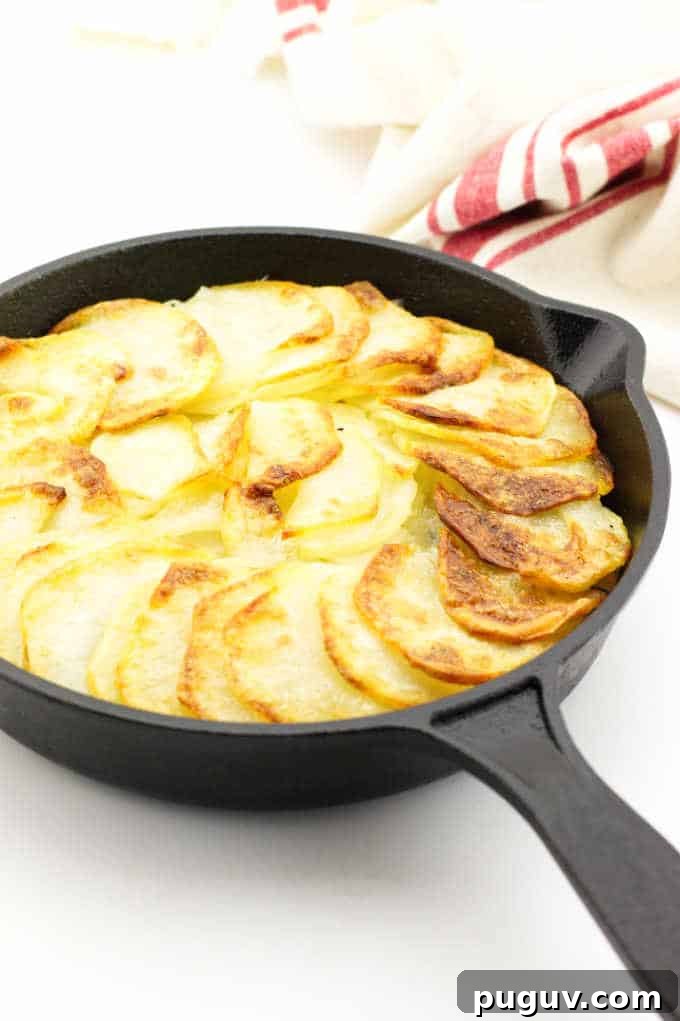
- Preheat the oven to 425°F. Lightly spray or butter a 10-inch skillet with sloping sides.
- Slice the peeled potatoes 1/8-inch thick using a sharp knife or mandoline.
- Add about 2 tablespoons of clarified butter to the pan and brush over the bottom and sides.
- Arrange a circular layer of potato slices in the center, slightly overlapping. Brush with more butter and season with salt and pepper.
- Continue layering the potatoes, alternating the direction of each layer, buttering and seasoning as you go. Drizzle any remaining butter over the top.
- Set the skillet over medium-high heat for 5–7 minutes, gently shaking occasionally to prevent sticking and begin browning.
- Remove from heat, cover with prepared foil (sprayed side down) and place a smaller pan or plate on top to press the potatoes firmly. Transfer to the oven and bake 15 minutes.
- Remove from the oven, press again, then bake uncovered an additional 15–20 minutes until the top is golden and the potatoes are tender when pierced.
- Hold a plate or lid over the skillet and invert to release the potato cake. Drain any excess butter if desired.
To serve
- Slide a thin spatula around the cake to loosen any stuck slices. Invert onto a serving plate so the browned side is up.
- Garnish with snipped chives and, if available, chive blossoms. Slice into pie-shaped wedges and serve immediately.
Notes
- If you use salted butter, reduce the additional salt in the layers.
- Eight tablespoons of butter yield roughly six tablespoons of clarified butter.
- Do not soak the sliced potatoes—keeping the surface starch helps the layers bind.
- Use a mandoline or 3mm food processor disc for the most uniform slices.
- Compressing the potatoes during baking is essential to forming a cohesive, crusty cake.
Nutrition
Nutrition information is an approximation and should be used as a guideline.
 Like this recipe? Try it and enjoy!