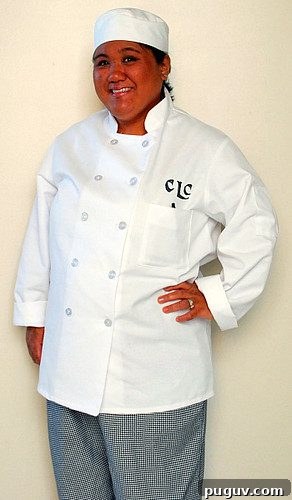
After years of informal cooking and baking in both home and commercial kitchens, I finally decided to take the next step: culinary school. I’ll be blogging my weekly impressions, summarizing what I’m learning and how the program is shaping my skills. Writing these posts helps me process lessons more deeply and become a better student. Welcome to my virtual kitchen classroom—come along as I share what I learn each week!
I’m enrolled at the local community college in its culinary arts program rather than a proprietary culinary institute. The program is recognized by the National Restaurant Association and is working toward accreditation with the American Culinary Federation, likely to be complete by the time I finish the program next summer or fall. I’m on the Professional Chef track and will earn a Professional Chef certificate when I complete the requirements. Based on my experience and goals, the faculty recommended this track. This semester I’m taking three courses: Food Service Sanitation, Nutrition, and Culinary Principles I.
Food Service Sanitation – This one-credit class runs only a few weeks, starting in mid-September and ending in late October, so there’s nothing substantial to report yet.
Nutrition – This course covers nutrition fundamentals and their application in the food service industry. We study food chemistry basics, nutrition across life stages, and special dietary needs. The class meets the nutrition requirement for American Culinary Federation (ACF) certification and recertification.
The Nutrition class has been engaging. Our instructor encourages discussion, and we cover topics ranging from popular diets and food movements to food processing and industry practices. Some students may find the subject dry, but I enjoy the blend of culinary culture, health, and science. It sparks thoughtful conversation about how food affects people and societies.
Homework: Heavy reading—three chapters this week—plus mini chapter quizzes and review of key terms for a quiz scheduled in two weeks.
Culinary Principles I – I’m particularly excited about this lecture/lab course. It introduces the foundations of commercial food preparation and essential culinary techniques. Topics include culinary history, modern food service development, kitchen brigades, sanitation and safety, recipe and menu structure, professional tools and equipment, knife skills, flavors, dairy, mise en place, basic cooking principles, stocks and sauces, and soup identification and preparation.
Chef S. teaches the class, which has about 16 students. The group is diverse in age and experience—some are industry veterans, others are beginners or career changers. That mix makes the classroom dynamic and valuable for learning. There was an unexpected schedule change for the lab: the school made an administrative error and we had to show up an hour and a half earlier than originally listed. Everyone adjusted and got to work.
In lecture we reviewed how restaurants developed historically (surprisingly recent—late 17th century), key figures and milestones in the culinary world, and professional standards in the kitchen. Food safety and sanitation were major topics: preventing contamination, proper food storage, illnesses from improper handling, and kitchen safety protocols. I also learned about Hazard Analysis and Critical Control Points (HACCP), a systematic approach for managing food safety in service operations.
In the lab—my favorite part—we began with identification exercises for herbs and spices and practiced common conversions (ounces to pounds, tablespoons to cups, quarts to gallons). The instructor handed out a quiz-like worksheet for identification and conversions; the winner would receive a prize. I arrived 15 minutes late because of the schedule change and felt rushed completing the handout, so I didn’t get the usual chance to double-check my answers.
After reviewing the answers, Chef S. announced a tie for the top score. I assumed I’d missed several items, but it turned out I was tied with another student. One of the herbs was mint, but the expected answer was spearmint specifically. My classmate had written spearmint and won the prize: a Henckels knife to add to her kit. The takeaway: be specific and proofread—especially when a prize is at stake!
We practiced knife skills by preparing a basic mirepoix—onion, carrot, celery—and some garlic. Chef S. used the carrots we chopped to make a simple glazed carrot side: carrots with cayenne, honey, brown sugar, and a bit of water. It was an easy, flavorful dish and a great example of how simple ingredients can shine.
Homework: A full plate for next week: one chapter to read, three chapters’ worth of discussion questions, and a two-page report on the hospitality industry. I’m also getting an early start on a three-page report and a 5–10 minute presentation about a chosen spice or herb. That assignment is due in two and a half weeks, and I’d rather not rush it at the last minute.
Despite the workload, I’m enjoying the classes. My husband teases that the reading feels like leisure reading to me—I’m a self-confessed food nerd. This week went well and it felt surreal when a few classmates recognized me from previous cooking events I hosted. One even attended a past “What’s Cookin, Chicago” gathering I ran at home. Small world indeed.
The only downside is the physical load: my culinary textbook is massive (1,181 pages) and heavy, but I can use it for multiple future courses. Add a nutrition textbook, folders, laptop and accessories, my knife kit, uniform, and camera bag (Chef S. encourages photos in the lab), and my daily trek to class becomes a workout—especially with the long walk from the parking area. If nothing else, I might lose a few pounds this semester.
Come back next week for another update from my virtual kitchen classroom.